Verkkokurssi

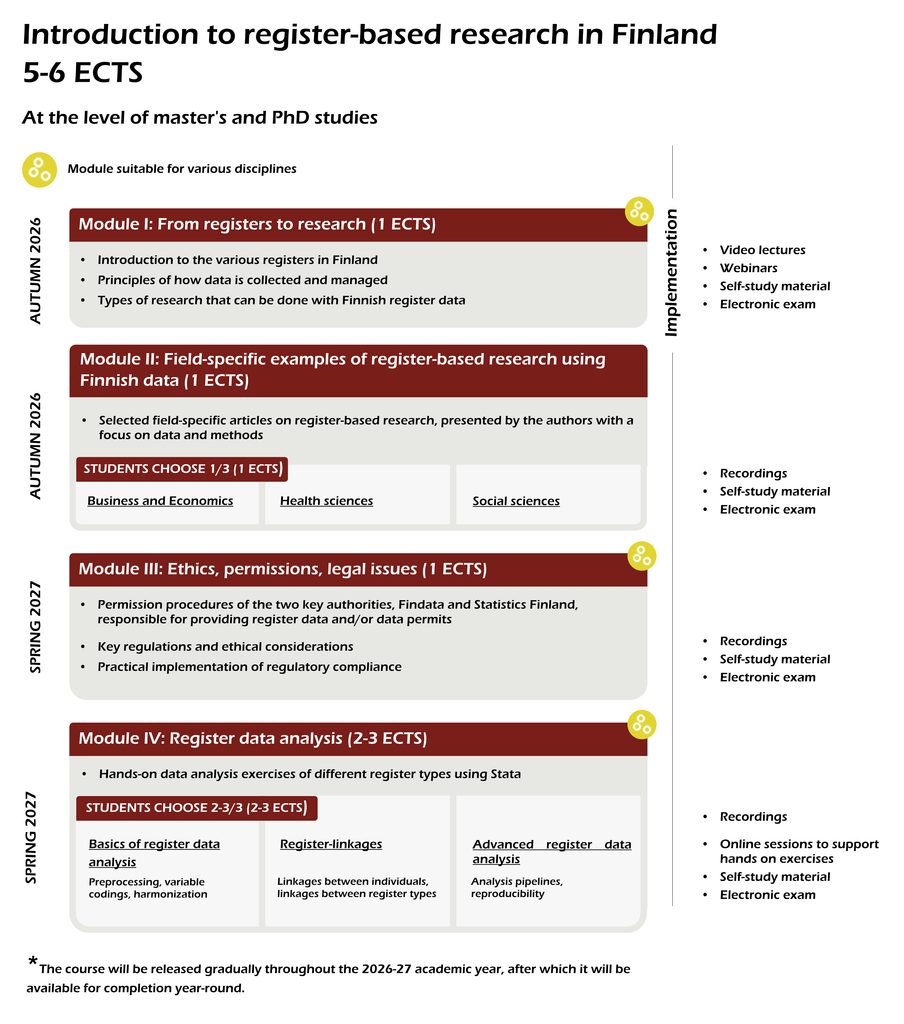
FIREn monitieteinen verkkokurssi Introduction to Register-based Research in Finland (5-6 ECTS-pistettä) johdattaa opiskelijat suomalaisten rekisteriaineistojen tarjoamiin tutkimusmahdollisuuksiin kauppa- ja talous-, terveys- ja sosiaalitieteissä.

Kurssi toteutetaan DigiCampus-oppimisympäristössä, joka on korkeakoulujen yhteinen valtakunnallinen oppimisalusta. Kurssin moduulit tulevat opiskelijoiden saataville lukuvuoden 2026–2027 aikana. Moduulit II ja III voi suorittaa itsenäisesti, sallien opiskelijoiden opiskella omassa tahdissaan. Moduulit I ja IV sisältävät muutamia aikataulutettuja oppimisaktiviteetteja, kuten webinaareja ja tutorointia. Moduuli I sisältää pakollisen webinaarin, jossa opiskelijat esittävät tutkimussuunnitelmansa ja Moduulissa IV on tarjolla tutorointia harjoitustöiden tueksi. Kurssilla yhdistyvät rekisteriaineistotutkimuksen monitieteiset perusteet, tieteenalakohtaiset tutkimusesimerkit, aineiston keruuseen ja hallintaan liittyvät eettiset ja oikeudelliset näkökulmat sekä käytännön rekisteriaineistojen analysointitaidot.

Kurssi koostuu neljästä moduulista:

  • Moduuli I: From Registers to Research (1 ECTS) esittelee rekisteriaineistojen perusteet ja Suomessa saatavilla olevat rekisterit. Opiskelijat saavat käsityksen siitä, millaisiin tutkimuskysymyksiin rekisteriaineistojen avulla voidaan vastata.
  • Moduuli II: Field-specific Examples of Register-based Research Using Finnish Data (1 ECTS) antaa opiskelijoille mahdollisuuden tutustua valitsemansa tieteenalan rekisteritutkimukseen kauppa- ja taloustieteiden, terveystieteiden tai sosiaalitieteiden näkökulmasta tutkimusartikkeleiden ja tutkijahaastatteluiden kautta.
  • Moduuli III: Ethics, Permissions and Legal Issues (1 ECTS) tutustuttaa opiskelijat rekisteriaineistojen käyttöoikeusprosesseihin, aineistoja koskevaan lainsäädäntöön ja tutkimuseettisiin näkökohtiin sekä keskeisten suomalaisten viranomaisten, kuten Findatan ja Tilastokeskuksen, rooleihin.
  • Moduuli IV: Register Data Analysis (2–3 ECTS) opettaa käytännön taitoja rekisteriaineistojen esikäsittelystä, yhdistämisestä ja analysoinnista Stata-ohjelmistolla.
Kurssin suoritettuaan opiskelijat hallitsevat rekisteriaineistojen keruun, hallinnoinnin ja käytön tutkimuksessa sekä ymmärtävät, millaisiin tutkimuskysymyksiin rekisteriaineistojen avulla voidaan vastata. Opiskelijat tuntevat tutkimuksen eettiset periaatteet ja rekisteriaineistoihin liittyvän lainsäädännön. Lisäksi opiskelijat ovat kartuttaneet käytännön kokemustaan aineiston käsittelystä ja analysoinnista Stata-ohjelmistolla.

Kurssi on suunnattu opiskelijoille, joilla on aiempaa kokemusta määrällisistä tutkimusmenetelmistä, kyky lukea ja tulkita tilastollisia menetelmiä käyttävien tutkimusten tuloksia ja perustaidot aineiston käsittelystä, mieluiten Stata-ohjelmistolla. Kurssin opetuskieli on englanti. Kurssille voivat ilmoittautua Turun yliopiston, Tampereen yliopiston, Jyväskylän yliopiston, Helsingin yliopiston ja Aalto-yliopiston opiskelijat. Ilmoittautuminen avautuu yliopistojen opintotietojärjestelmien kautta syksyllä 2026.


Kurssirakenne (englanniksi)

Learning outcomes

By the end of the course, the student knows how register data is collected and managed, and what kinds of register data is available for research use. The student understands what kinds of research questions can be addressed with register data.

Content

Recordings of lectures introduce students to register data. The lectures cover topics such as what is register data, how is register data different from other types of quantitative data, what kinds of register data are available in Finland, and what kinds of research can be done with registers. Students are given tasks to familiarize them with Finnish register data. Students make up a basic research plan using register data and present it at a webinar.

It is recommended that students also familiarize themselves with the content of one of the ‘Module II: Field-specific examples of register-based research using Finnish data’ at the same time as this module, in particular before making their own research plan.

Study methods

Assessment is based on an electronic exam (eEXAM) and the presentation of a research plan.

Course unit methods

The course includes recordings of lectures and webinars where the students present their research plan.

Assessment scale

Pass/Fail

Languages

English

Level

Advanced Studies

Qualifications

Previous knowledge of quantitative research methods. Ability to read articles that have used standard statistical analyses (such as regression analyses or other more advanced quantitative methods) and interpret the results. Basics of data management (preferably in Stata).

Further information

This is a mandatory course of the study module: ‘Introduction to register-based research in Finland (5-6 ECTS)’.

The student chooses one of the following field-specific courses:

  • Field-specific examples of register-based research using Finnish data, Business and Economics (1 ECTS, organized by the University of Jyväskylä)
  • Field-specific examples of register-based research using Finnish data, Health sciences (1 ECTS, organized by the Tampere University)
  • Field-specific examples of register-based research using Finnish data, Social sciences (1 ECTS, organized by the University of Turku)

Learning outcomes

The student becomes familiar with previous field-specific empirical research conducted using Finnish register data. The student understands the different data set-ups required for answering different kinds of research questions.

Content

This course introduces selected field-specific studies that have used register data, with particular attention focused on the data and methods used in the studies. The example studies cover various research settings, such as over-time trends, life-course studies, intergenerational studies, and studies of contextual influences. The course materials consist of recordings available through the course DigiCampus environment and the example articles. Students explore the topic by reading the articles and engaging with interview recordings in which the authors discuss their research.

It is recommended that the student has also started taking course ‘From Registers to Research’ when taking this course.

Study methods

Assessment is based on an electronic exam (eEXAM).

Course unit methods

The course consists of recordings and research articles.

Assessment scale

Pass/Fail

Languages

English

Level

Advanced Studies

Qualifications

Previous knowledge of quantitative research methods. Ability to read articles that have used standard statistical methods (such as regression analyses or other advanced quantitative methods) and interpret the results. Basics of data management (preferably using Stata).

Further information

This course is one of the three options for the Module II in the course ‘Introduction to register-based research in Finland (5-6 ECTS)’.

Learning outcomes

The student becomes familiar with previous field-specific empirical research conducted using Finnish register data. The student understands the different data set-ups required for answering different kinds of research questions.

Content

This course introduces selected field-specific studies that have used register data, with particular attention focused on the data and methods used in the studies. The example studies cover various research settings, such as over-time trends, life-course studies, intergenerational studies, and studies of contextual influences. The course materials consist of recordings available through the course DigiCampus environment and the example articles. Students explore the topic by reading the articles and engaging with interview recordings in which the authors discuss their research.

It is recommended that the student has also started taking course ‘From Registers to Research’ when taking this course.

Study methods

Assessment is based on an electronic exam (eEXAM).

Course unit methods

The course consists of recordings and research articles.

Assessment scale

Pass/Fail

Languages

English

Level

Advanced Studies

Qualifications

Previous knowledge of quantitative research methods. Ability to read articles that have used standard statistical methods (such as regression analyses or other advanced quantitative methods) and interpret the results. Basics of data management (preferably using Stata).

Further information

This course is one of the three options for the Module II in the course ‘Introduction to register-based research in Finland (5-6 ECTS)’.

Learning outcomes

The student becomes familiar with previous field-specific empirical research conducted using Finnish register data. The student understands the different data set-ups required for answering different kinds of research questions.

Content

This course introduces selected field-specific studies that have used register data, with particular attention focused on the data and methods used in the studies. The example studies cover various research settings, such as over-time trends, life-course studies, intergenerational studies, and studies of contextual influences. The course materials consist of recordings available through the course DigiCampus environment and the example articles. Students explore the topic by reading the articles and engaging with interview recordings in which the authors discuss their research.

It is recommended that the student has also started taking course ‘From Registers to Research’ when taking this course.

Study methods

Assessment is based on an electronic exam (eEXAM).

Course unit methods

The course consists of recordings and research articles.

Assessment scale

Pass/Fail

Languages

English

Level

Advanced Studies

Qualifications

Previous knowledge of quantitative research methods. Ability to read articles that have used standard statistical methods (such as regression analyses or other advanced quantitative methods) and interpret the results. Basics of data management (preferably using Stata).

Further information

This course is one of the three options for the Module II in the course ‘Introduction to register-based research in Finland (5-6 ECTS)’.

Learning outcomes

By the end of the course, the student can identify and describe the roles of the two key authorities responsible for providing register data and/or data permits in Finland (Findata, Statistics Finland), and describe key regulations and ethical considerations as well as their implementations in register-based research. Students will understand the practical implementation of regulatory compliance, including the use of secure remote access systems and the procedures required to obtain permissions for data access.

Content

Course materials introduce students to ethics, permissions, legal issues, and practical aspects of regulatory compliance, such as working in remote access environments and navigating data access application procedures. These cover topics such as the roles of the two key authorities responsible for data permits (Findata, Statistics Finland), and key regulations and ethical considerations in register-based research in Finland.  Students are given tasks to familiarize them with the course topics.

Study methods

Assessment is based on an electronic exam (eEXAM).

Course unit methods

The course includes recordings and independent work with self study materials provided during the course.

Qualifications

Previous knowledge of quantitative research methods. Ability to read articles that have used standard statistical analyses (such as regression analyses or other more advanced quantitative methods) and interpret the results. Basics of data management (preferably in Stata).

Assessment scale

Pass/Fail

Languages

English

Level

Advanced Studies

Further information

This is a mandatory course of the study module: ‘Introduction to register-based research in Finland (5-6 ECTS)’.

Students may complete this module for either 2 ECTS or 3 ECTS credits. To earn 2 ECTS, students must complete the course ”Linking register datasets” (1 ECTS), and choose either ”Basics of register data analysis” (1 ECTS) or ”Advanced register data analysis” (1 ECTS), depending on their prior skill level. To earn 3 ECTS, students must complete all three courses.

Learning outcomes

The student will learn basic skills related to the implementation and processing of register data sets, including:

  • Importing and browsing data (e.g., using the data browser, tabulating variable values, sorting data based on variable values, and calculating descriptive statistics of variables).
  • Editing data to make it suitable for statistical analysis (e.g., inspecting and editing missing or incorrectly coded variable values, changing variable types, and creating new variables based on existing variables).
  • Performing simple statistical analyses (e.g., cross-tabulations, correlation coefficients, and simple OLS regressions).

Content

These basic skills are practiced using statistical software Stata.
The course consists of recordings and independently completed hands-on exercises on processing register data (the exercises are supported by online tutoring sessions).

Study methods

Assessment is based on an electronic exam (eEXAM).

Course unit methods

The course includes recordings and independently completed hands-on exercises.

Qualifications

Previous knowledge of quantitative research methods. Ability to read articles that have used standard statistical methods (such as regression analyses or other advanced quantitative methods) and interpret the results. Basics of data management (preferably using Stata).

Assessment scale

Pass/Fail

Languages

English

Level

Advanced Studies

Further information

This course is one of the two options for the Module IV in the course ‘Introduction to register-based research in Finland (5-6 ECTS)’.

Learning outcomes

The student can merge and modify different types of register data, including:

  • Combining register datasets from different time periods.
  • Combining different register datasets of the same individuals.
  • Combining aggregate-level data with individual-level register data.
  • Utilizing register data that contain date variables.

In addition, the student learns to use classification crosswalks and utilize simple loops in processing register data.

Content

These skills are practiced using statistical software Stata.

The course consists of recordings and independently completed hands-on exercises (the exercises are supported by online tutoring sessions).

Study methods

Assessment is based on an electronic exam (eEXAM).

Course unit methods

The course includes recordings and tasks to be completed independently.

Qualifications

Previous knowledge of quantitative research methods. Ability to read articles that have used standard statistical analyses (such as regression analyses or other more advanced quantitative methods) and interpret the results. Basics of data management (preferably in Stata).

Assessment scale

Pass/Fail

Languages

English

Level

Advanced Studies

Further information

This is an mandatory course of the study module: ‘Introduction to register-based research in Finland (5-6 ECT)’.

Learning outcomes

After the course, the student understands principles of efficient programming for register data. This includes organization of codes, application of macros and loops, and other higher-level automation. Students know how to organize their own analysis efficiently, clearly and in a replicable way. Students can utilize loops in their coding.

Content

These skills are practiced using statistical software Stata.

The course consists of recordings and independently completed hands-on exercises on combining and modifying register datasets (the exercises are supported by online tutoring sessions).  

Study methods

Assessment is based on an electronic exam (eEXAM).

Course unit methods

The course includes recordings and independently completed hands-on exercises.

Qualifications

Basics of data management (preferably using Stata).

Previous knowledge of quantitative research methods. Ability to read articles that have used standard statistical methods (such as regression analyses or other advanced quantitative methods) and interpret the results.

For this advanced register data analysis course, students should have completed, or possess equivalent knowledge and skills, to the course ’Basics of Register Data Analysis’, and to have completed the course ‘Linking register datasets’.

Assessment scale

Pass/Fail

Languages

English

Level

Advanced Studies

Further information

This course is one of the two options for the Module IV in the course ‘Introduction to register-based research in Finland (5-6 ECTS)’.

For this advanced register data analysis course, students should have completed, or possess equivalent knowledge and skills, to the course ’Basics of Register Data Analysis’, and to have completed the course ‘Linking register datasets’.

Suomen Akatemia rahoittaa FIRE-infrastruktuurin kehittämistä ja rakentamista vuosina 2025–2028 (päätösnumero 367675).

Saavutettavuusseloste